|

New & Back in Stock 01-31-2026

Lake Verea: Modern Barragan
$62
A diaristic archive of pilgrimages to Luis Barragán's modernist abode.
In this intimate archive, the contemporary Mexican photographer duo Lake Verea record their pilgrimages, made over the course of nearly two decades, to the house of Mexican architect Luis Barragán (1902–88). As devotees of the architect, the duo began photographing the...

Sir Edwin Lutyens: Britain’s Greatest Architect?
$25
• Professor Clive Aslet, chairman of the Lutyens Trust, reveals the journey behind the buildings designed by Lutyens. This book digs deep into the archives, showcasing both Aslet's knowledge and unseen artwork and stories from the archives of the Lutyens Trust. Both commercial and personal commissions and stories reveal the...

The Wrigley Building The Making of an Icon
$95
An in-depth look at America’s historic skyscraper and Chicago’s most iconic building.
This is the captivating story of the spectacular architecture of the century-old Wrigley Building—its design, construction, and enduring significance as one of Chicago’s most emblematic buildings. Through meticulous research and spectacular photography, the book unearths a century’s worth of...
This is the captivating story of the spectacular architecture of the century-old Wrigley Building—its design, construction, and enduring significance as one of Chicago’s most emblematic buildings. Through meticulous research and spectacular photography, the book unearths a century’s worth of...

The Watercolors of Skurman Architects
$80
This portfolio contains 50 watercolor prints and an accompanying hardback book. These architectural drawings come from the San Francisco office of Skurman Architects, founded by Andrew Skurman in 1992, which is known for the elegance of its work in the different classical styles. Accompanied by a text explaining the context...

Resonances: Klanghaus Toggenburg
$60
The Klanghaus Toggenburg, located in the northeast of Switzerland and host to musical rehearsals, courses and concerts alike, is a place that enables visitors to experience a unique interplay of architecture, sound and nature. The Klanghaus in the Swiss Canton St. Gallen is the result of an impressive twenty-year development process: based on a concept by the late Marcel Meili, which won the 2010 thesis competition for the building, it was then realized by architect Astrid Staufer with the office Staufer & Hasler and opens its doors to the public in May of 2025. It is at its core a fundamentally social project, comprised of the work of all those involved in this process.

Architecture Without Architects: A Short Introduction to Non-Pedigreed Architecture
$24.95
In this book, Bernard Rudofsky steps outside the narrowly defined discipline that has governed our sense of architectural history and discusses the art of building as a universal phenomenon. He introduces the reader to communal architecture--architecture produced not by specialists but by the spontaneous and continuing activity of a whole...

Echo's Chambers Architecture and the Idea of Acoustic Space
$65
A room’s acoustic character seems at once the most technical and the most mystical of concerns. Since the early Enlightenment, European architects have systematically endeavored to represent and control the propagation of sound in large interior spaces. Their work has been informed by the science of sound but has also...

Data Centers: Edges of a Wired Nation
$40
An investigation into the complex politics of data centers, through photographs and essays.
Often hidden in plain sight, data centers are the backbone of our internet. They store, communicate and transport the information we produce and access daily along invisible pathways. The industry of data centers comes entwined with an...

Magic Architecture The Story of Human Housing
$75
The first publication of artist and architect Frederick Kiesler’s epoch-spanning history of human architecture, largely unknown but still relevant.
Magic Architecture was the architect Frederick Kiesler’s most ambitious book project, an epoch-spanning history of human housing from prehistory to the atomic era, submitted to editors after World War II but left...
Magic Architecture was the architect Frederick Kiesler’s most ambitious book project, an epoch-spanning history of human housing from prehistory to the atomic era, submitted to editors after World War II but left...

Arab Design Now
$50
Designers from across the Arab world reinterpreting and preserving a rich cultural heritage through contemporary design.
Featuring over 250 color illustrations, Arab Design Now presents a survey of local and regional design talent across disciplines, from architectural and material innovations to contemporary crafts, furniture, fashion, and graphic and object design....

A Territory in Conflict: Eras of Development and Urban Architecture in Gaza
$65
A Territory in Conflict explores Israeli and Palestinian projects of modernization and development in the Gaza Strip, from the outset of Israel's military occupation in 1967 to the Oslo Accords of 1993. Rather than reduce the Gaza Strip to an arena of war and violence, Fatina Abreek-Zubiedat resurrects the urban...

Concrete Colonialism: Architecture, Urbanism, and the US Imperial Project in the Philippines
$29.95
During US colonial rule in the Philippines, reinforced concrete was used to the near exclusion of all other building materials. In Concrete Colonialism, Diana Jean S. Martinez examines the motivations for and lasting effects of this forgotten colonial policy. Arguing that the pervasive use of reinforced concrete technologies revolutionized techniques...

The House Is (Not) a Prison: On the Queerness of Architecture
$44.95
Where is sexuality, especially queer sexuality, in architecture? The House Is (Not) a Prison approaches this question from a radically new position, looking not for a theory of queer architecture, but rather for a queer theory of architecture. Starting from a reconsideration of the foundational principles of architecture, Colin Ripley...

The Farm at Black Mountain College
$35
Black Mountain College (BMC) was a wellspring of 20th-century creative unorthodoxy. From its founding in 1933 and over its celebrated 23-year history, the small liberal arts school in rural North Carolina attracted a remarkable number of famous and soon-to-be famous artists, writers and visionaries including Anni and Josef Albers, Ruth...

World Observation: Empire, Architecture, and the Global Archive of Itō Chūta
$75
World Observation explores the archives and architecture of Itō Chūta (1867-1954), the eminent architectural thinker of the Japanese empire, who traveled across Asia, Europe, and North America to create the first world history of architecture in Japanese from a truly global set of encounters. In his mission to integrate Japan...

Writing Architectural History: Evidence and Narrative in the Twenty-First Century
$45
Over the past two decades, scholarship in architectural history has transformed, moving away from design studio pedagogy and postmodern historicism to draw instead from trends in critical theory focusing on gender, race, the environment, and more recently, global history, connecting to revisionist trends in other fields. With examples across space...
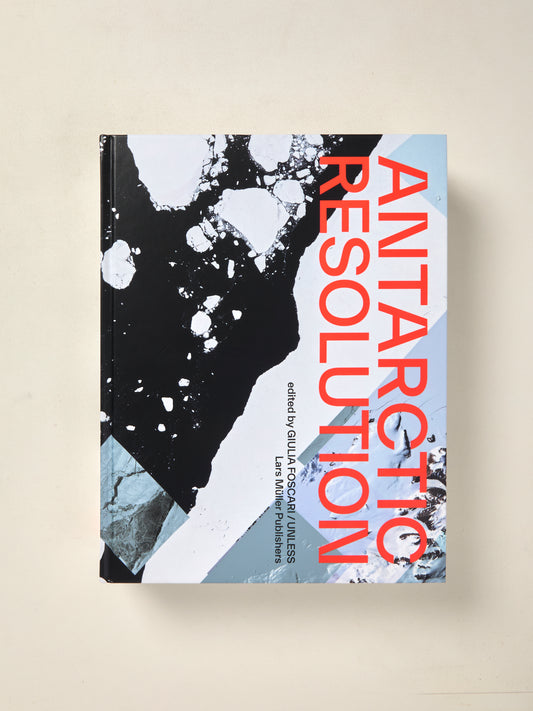
Antarctic Resolution
$80
Accounting for approximately 10% of the land mass of Planet Earth, the Antarctic is a global commons we collectively neglect. Far from being a pristine natural landscape, the continent is a contested territory which conceals resources that might prove irresistible in a world with ever-increasing population growth. The 26 quadrillion tons of ice accumulated on its bedrock, equivalent to around 70% of the fresh water on our planet, represent at once the most significant repository of scientific data available, providing crucial information for future environmental policies, and the greatest menace to global coastal settlements threatened by the rise in sea levels induced by anthropogenic global warming.
Antarctic Resolution advocates the rejection of the pixelated view of Antarctica offered to us by big data companies and urges the construction of a high-resolution image focusing on the continent’s unique geography, unparalleled scientific potential, contemporary geopolitical significance, experimental governance system and its extreme inhabitation model. Only the concerted determination of a transnational network of multidisciplinary polar experts―represented here in the form of authored texts, photographic essays and data-based visual portfolios―could construct such an image and reveal the intricate web of growing economic and strategic interests, tensions and international rivalries, which are enveloped in darkness, as is the continent for six months of the year.

Tending the Wild: Native American Knowledge and the Management of California's Natural Resources
$34.95
A complex look at California Native ecological practices as a model for environmental sustainability and conservation.
John Muir was an early proponent of a view we still hold today—that much of California was pristine, untouched wilderness before the arrival of Europeans. But as this groundbreaking book demonstrates, what Muir was really...

Alphabet in Motion: How Letters Get Their Shape
$85
With an interactive cover, 17 pop-ups and hands-on activities throughout, Alphabet in Motion is an immersive introduction unlike any other to the history of typography and letter shapes.
Ever wonder how we ended up with so many different styles of letters? Open any text editor, email client or design app and you will immediately be bombarded with a buffet of typographic choices. Serif or sans serif? Display or text? Classical or contemporary? Formal or casual?
Featuring 17 stunning interactive pop-ups, this ABC pop-up book explains--as well as demonstrates--the technologies and philosophies that have shaped letterforms through the ages. Readers will learn about '60s psychedelic type by projecting light through a phototypesetting pop-up; how screen technology shaped letterforms by turning on and off anti-aliasing; or the aesthetics of typographic modularity by reconfiguring the puzzle pieces of Josef Albers' Kombinations-Schrift.

James Turrell: A Retrospective
$85
The only comprehensive volume on James Turrell is back in print--from early prints and light projections to his monumental Roden Crater project.
This definitive book illuminates the origins and motivations of James Turrell's incredibly diverse and exciting body of work--from his Mendota studio days to his monumental work-in-progress Roden Crater....
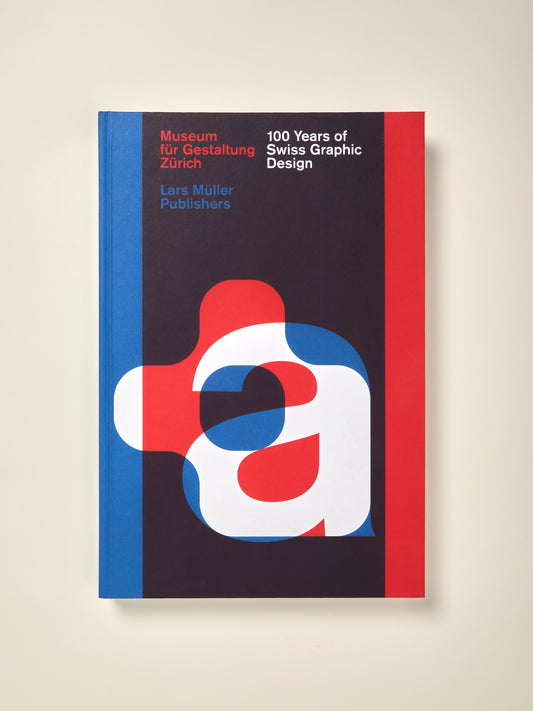
100 Years of Swiss Graphic Design
$65
100 Years of Swiss Graphic Design takes a fresh look at Swiss typography and photo-graphics, posters, corporate image design, book design, journalism and typefaces over the past hundred years. With illuminating essays by prominent experts in the field and captivating illustrations, this book, designed by the Zurich studio NORM, presents...
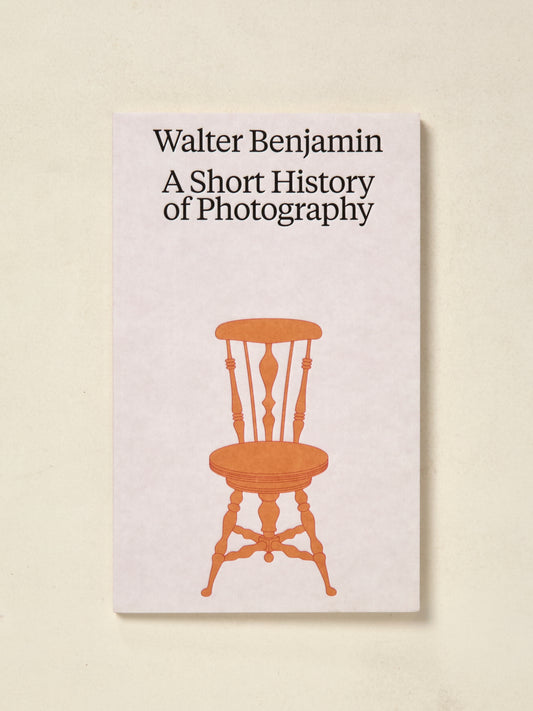
A Short History of Photography
$14
Benjamin’s early attempt to understand a nascent technology, remarkably prescient and topical even today
“The illiterate of the future … will not be the man who cannot read the alphabet, but the one who cannot take a photograph.” So declared Walter Benjamin (1892–1940) in his essay A Little History of Photography,...
“The illiterate of the future … will not be the man who cannot read the alphabet, but the one who cannot take a photograph.” So declared Walter Benjamin (1892–1940) in his essay A Little History of Photography,...

Moirémotion
$30
Kurashima’s interactive book objects feature graphic patterns that are animated by the reader/viewer with a special foil contained within the book, so that figures and forms are created out of optical overlays, set in motion and then...